
Reference:
- Kozier & Erb’s Fundamentals of Nursing: Concepts, Process, and Practice, 11th Edition, ISBN 9780135428733, by Audrey Berman, Shirlee J. Snyder, and Geralyn Frandsen (Ch. 16, pp. 295–320)
Communication is any means of exchanging information or feelings between two or more individuals. The communication process is built on a trusting relationship with a client and the client’s support people. Effective communication is essential for the establishment of an effective nurse-client relationship. Therapeutic communication promotes understanding and can help establish a constructive relationship between the nurse and the client. This relationship is client-centered and goal-oriented.
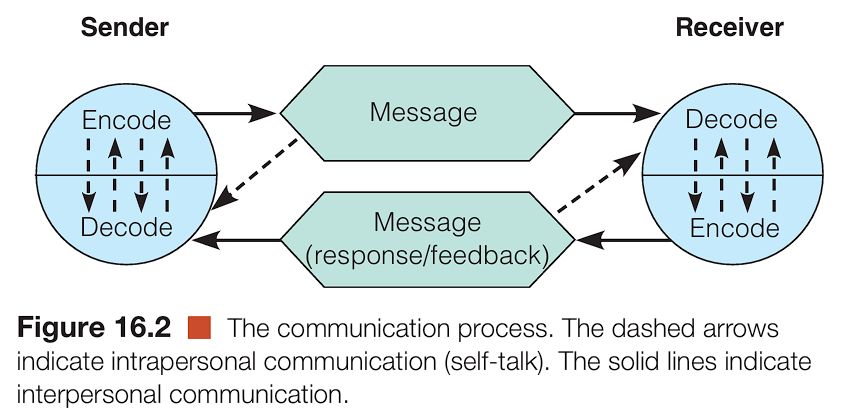
- Sender: the party wishing to communicate; also known as the “source encoder”. Encoding is the conversion of thought or information into a desired method to convey the message.
- Message: the second component of the communication process. This is what was actually said, written, or shown and in what medium. This includes forms such as electronic communication, therapeutic touch, and other nonverbal channels.
- Receiver: the third component of the communication process; the “decoder”. Communication becomes effective if the receiver decodes a meaning from the message that matches the intent of the sender.
- Response: the fourth component of the communication process; the “feedback”. It is the resulting message that the receiver returns to the sender.
Factors Influencing the Communication Process
- Development: language, psychosocial, and intellectual development across the lifespan require various modifications to messages accordingly, such as the use of dolls and games coupled with simple language to explain a procedure to an 8-year-old.
- Gender: from an early age, females and males communicate differently. Girls tend to use language to seek confirmation, minimize differences, and establish intimacy. Boys use language to establish independence and negotiate status within a group. These differences can continue into adulthood, so a man and a woman may interpret the same communication differently.
- Values and Perception: Values are the standards that influence behavior, and perceptions are personal views of an event or situation. Each individual will have a unique blend of values and will perceive and interpret messages and experiences differently.
- Personal Space (Proxemics): the physical distance between two people who are communicating. The nature of communication may vary in accordance with four distances, each with a close and a far phase.
| Distance | Character | |
|---|---|---|
| Intimate | 0 to 1 1/2 feet | Body contact, body heat, smell, and low vocalization. Perception is limited to a small area of the body, which may distort inerpretation. |
| Personal | 1 1/2 to 4 feet | Moderate voice tones. Physical contact is limited to handshakes or touching a shoulder. More of the body is visible from a distance, making perception of body stance or full facial expressions less distorted. |
| Social | 4 to 12 feet | Clear visual perception of the whole individual. Eye contact is increased and vocalizations are loud enough to be overheard by others. This limits communication to formal matters; this allows for expedient communication to several people at the same time. |
| Public | 12 feet and beyond | Loud, clear vocalizations with clear enunciation are required. Individuality is lost; perception is of the group of people or the community. |
- Territoriality: the concept of space and things that an individual considers as belonging to the self.
- Roles and Relationships between the sender and receiver affect the communication process. The content and responses are altered in differing relationships such as nursing student and instructor, client and primary care provider, or parent and child. Choice of words, sentence structure, and tone of voice vary considerably from role to role.
- Environment: a comfortable environment will allow for the most effective communication. Extremes in temperature or noise, poor ventilation, and loss of privacy can all interfere with communication.
- Congruence: the agreement of both verbal and nonverbal aspects of a message. If the nurse’s communication appears congruent, trustworthiness is improved and miscommunication is prevented.
- Interpersonal Attitudes: attitudes convey beliefs, thoughts, and feelings about people and events. Attitudes such as caring, warmth, respect, and acceptance facilitate communication , whereas condescension, lack of interest, and coldness inhibit communication.
- Boundaries: “defining limits of individuals, objects, or relationships”. For nurses, professional boundaries are crucial in the context of nurse-client relationship. To maintain clear boundaries, the nurse keeps the focus on the client and avoids sharing personal information.