References:
- Kozier & Erb’s Fundamentals of Nursing: Concepts, Process, and Practice, 11th Edition, ISBN 9780135428733, by Audrey Berman, Shirlee J. Snyder, and Geralyn Frandsen (Ch. 35, pp. 848–851)
In the Philippines, a mix of the metric system, imperial system, and household system is used.
Metric System
The metric system is prescribed by law in most European countries and in Canada. It is logically organized into units of 10; it is a decimal system. Basic units can be multiplied or divided by 10 to form secondary units. Multiples are calculated by moving the decimal point to the right, and division is accomplished by moving the decimal point to the left.
The basic units of measurement are the meter (length), liter (volume, usually for fluids), and gram (weight). These are augmented with prefixes derived from Latin to designate multiples and divisions of the basic unit. Commonly used multiples and subdivisions of these values include:
- Meter: centimeters and millimeter
- Liter: liters and milliliters
- Gram: kilogram, milligram, microgram
| Prefix | Value | Abbreviation |
|---|---|---|
| nano | 0.000000001 | n |
| micro | 0.000001 | µ or mc |
| milli | 0.001 | m |
| centi | 0.01 | c |
| deci | 0.1 | d |
| - | 1 | g |
| deka | 10 | da |
| hecto | 100 | h |
| kilo | 1000 | k |
To show the application of these prefixes to the basic units, take a meter for example:
- A kilometer (km) is equal to 1000 meters.
- A centimeter (cm) is equal to 0.01 meters.
- A millimeter (mm) is equal to 0.001 meters, or 0.1 centimeters.
As mentioned, converting between multiples of a unit in the metric system can be as simple as moving the decimal point respective to each unit’s size.:
- 350 meters to kilometers = . 350 is divided by 1000 because that’s how many meters is in a kilometer.
- 12 centimeters to meters = . 12 is divided by 100 because that’s how many centimeters is in a meter.
When Conversion is Important
Conversions between metric units are important for when a formula presents two values that aren’t of the same scale. Take this problem, for example:
A client has developed an infection after sustaining second-degree burns. The physician prescribes 250 mcg of drug X every 12 hours. The stock medication is available in a 10-mL ampule that contains 2 mg of drug X.
The desired dose is in micrograms, but the stock dosage is in milligrams. Before applying the DSQ formula, these two values should be of the same unit.
- You must first know that 1 microgram is equal to 1000 milligrams.
- 250 micrograms to milligrams = .
- Apply the DSQ formula:
- Conclusion: the nurse must administer 1.25 mL of the ampule to deliver 250 mcg of drug X.
Note that the same conclusion can be reached by converting milligrams into micrograms: also yields 1.25 mL. The important part is to match the units.
Further information on conversion is discussed later in this page.
Weight vs. Volume
In nursing practice it is important to understand the difference between weight and volume. A drug dosage may be ordered by weight (i.e., grams, mg, mcg), but administered by volume (mL). For example, a healthcare provider prescribes 20 mg (weight) of codeine in an elixir (liquid) form.
- The codeine elixir bottle is labeled 10 mg per 5 mL. This means there are 10 milligrams of codeine in 5 mL of fluid.
- The nurse administers 10 mL (volume) of codeine elixir to deliver 20 mg (weight) of codeine. More about drug calculations is discussed later in this page.
Household System
Household measures may be used when more accurate systems of measure are not required. Included in household measures are drops, teaspoons, and table- spoons. Approximate volume equivalents between metric and household systems include:
- 15 drops = 1 mL
- 4 mL = 1 teaspoon, sometimes approximated as 3 teaspoons = 1 tablespoon
- 15 mL = 1 tablespoon
In the Philippine setting, some household systems still include apothecary units. These include:
Converting Units of Weight and Measure
Converting Weights within the Metric System
It is relatively simple to arrive at equivalent units of weight within the metric system because the system is based on units of 10. Only three metric units of weight are used for drug dosages, the gram (g), milligram (mg), and microgram (mcg): 1000 mg or 1,000,000 mcg equals 1 gram (g). Equivalents are computed by dividing or multiplying; for example, to change milligrams to grams, the nurse divides the number of milligrams by 1000. The simplest way to divide by 1000 is to move the decimal point three places to the left:
It is important to put a 0 in front of the decimal point; otherwise, the reader may miss the decimal point and administer a wrong dose of medication.
Conversely, to convert grams to milligrams, multiply the number of grams by 1000, or move the decimal point three places to the right:
Converting Units of Volume
Liters and milliliters are the volumes commonly used in preparing solutions for enemas, irrigating solutions for bladder irrigations, and solutions for cleaning open wounds. In some situations, the nurse needs to convert the volumes of such solutions.
Converting Units of Weight
The units of weight most commonly used in nursing practice are the gram, milligram, and kilogram. Learning these equivalents helps the nurse make weight conversions readily, as when converting pounds to kilograms and vice versa when determining an individual’s weight. When converting pounds to kilograms, the nurse converts by dividing or multiplying by 2.2:
Inversely, converting kilograms to pounds:
Methods of Calculating Doses
Guidelines for Rounding Numbers in Drug Calculations
- General Rules:
- Quantities greater than 1 are rounded to the nearest tenth. (1.63 → 1.6)
- Quantities less than 1 are rounded to the nearest hundredth. (0.825 → 0.83)
- Oral Medications:
- Capsules cannot be divided.
- Scored tablets may be divided.
- For tablets without scores and capsules, it may not be realistic to administer the exact amount as calculated. For example, the nurse may give 2 tablets or capsules if they calculate to be 1.9 tablets or capsules.
- If the oral medication is a liquid, accurate measurement can be aided by choosing the right syringe—tuberculin syringes have markings for hundredths of a milliliter, 3-mL syringes have markings indicating one-tenth of a milliliter, and larger syringes (e.g., 10-mL) indicate a 0.2-mL increment.
- Parenteral Medications: rounding depends on the amount (i.e., less than or more than 1) and the syringe used. As indicated above, a TB syringe can be used for very small amounts (e.g., to the hundredth of a mL). Larger syringes would be used for rounding to a tenth of a milliliter.
- IV Infusion:
- By gravity, round to the nearest whole number. (37.5 → 38 gtts/min)
- By IV pump, it is possible to set the pump to the nearest tenth. (1.25 → 1.3 mL/h)
- Rounding down may be used in pediatrics or for high-alert medications to adults. This is done to avoid an overdose. When rounding, simply drop digits to the desired place.
6.6477rounded down to hundredths is6.64, down to tenths is6.6, and down to the whole number is6.
Basic Formula
The basic formula for calculating drug dosages is commonly used and easy to remember:
- D = desired dose (i.e., dose ordered by primary care provider)
- H = dose on hand (i.e., dose on label of bottle, vial, ampule)
- V = vehicle (i.e., form in which the drug comes, such as tablet or liquid).
Alternatively, in the Philippines, this formula is notated with "D" for desired dose, "S" for stock, and "Q" for quantity (vehicle).
Examples
- A 35-year-old patient is prescribed Erythromycin 500 mg PO every 6 hours. The available medication is Erythromycin 250 mg in 5 mL syrup. How much volume should the nurse administer?
- A patient is ordered Lanoxin 0.5 mg PO daily. The available drug is Lanoxin 250 mcg per tablet. How many tablets should the nurse give?
Ratio and Proportion Method
The ratio and proportion method is considered the oldest method used for calculating dosage problems. The equation is set up with the known quantities on the left side (i.e., and ). The right side of the equation consists of the desired dose (i.e., ) and the unknown amount to administer (i.e., ). The equation looks like this:
Once the equation is set up, multiply the extremes (i.e., and ) and the means ( and ). Then solve for .
Examples
- The order is for Keflex 750 mg PO. On hand, you have Keflex 250 mg capsules. How many capsules should you administer?
- The order is for Diflucan 0.4 g PO. On hand, you have Diflucan 200 mg tablets. How many tablets should be given?
Fractional Equation Method
The fractional equation method is similar to ratio and proportion, except it is written as a fraction:
The formula consists of cross multiplying and solving for :
Examples
- The order is for Lanoxin 0.25 mg PO. The available supply is Lanoxin 0.125 mg tablets.
- The order is for Daypro 1.8 g PO once daily. On hand, the medication is available as 600 mg caplets. How many caplets are needed?
Calculation for Individualized Drug Dosages
Individualized doses are often used for pediatric clients, chemotherapy, and clients who are critically ill. The two methods for individualizing drug dosages are body weight and body surface area.
Body Weight
Unlike adult dosages, children’s dosages are not always standard. Body weight significantly affects dosage; therefore, dosages are calculated. Dosages based on weight use kilograms of body weight and per kilogram medication recommendations to arrive at appropriate and safe doses.
- Convert pounds to kilograms, if necessary.
- Determine the drug dose per body weight by multiplying
drug dose×body weight×frequency. - Choose a method of drug calculation to determine the amount of medication to administer (discussed earlier).
Example
The order is for Keflex, 20 mg/kg/day in three divided doses. The client weighs 20 pounds. The medication on hand is an oral suspension of Keflex with 125 mg per 5 mL.
- Convert pounds to kilograms:
- Multiply drug dose × body weight × frequency:
Body Surface Area
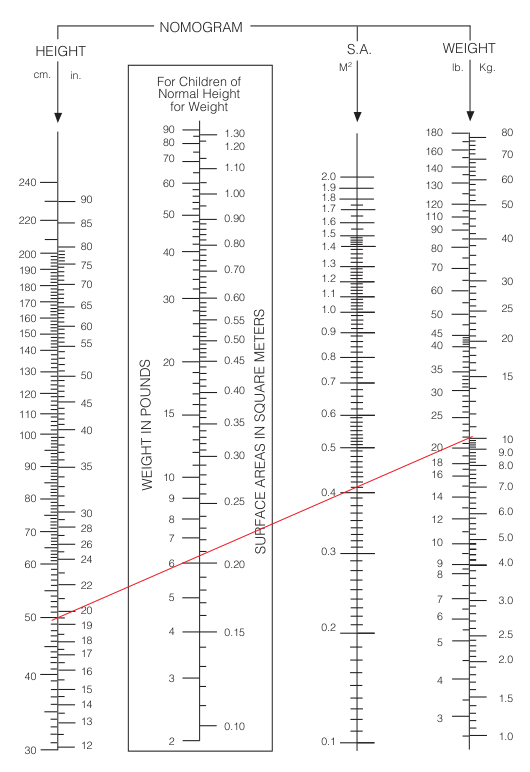
Sometimes the body surface calculation may be used instead of body weight to individualize the medication dosage. It is considered to be the most accurate method of calculating a child’s dose. Body surface area is determined by using a nomogram and the child’s height and weight. The formula is the ratio of the child’s body surface area to the surface area of an average adult (1.7 square meters, or 1.7 m²), multiplied by the normal adult dose of the drug:
Body Surface Area Normogram
This normogram is used by drawing a straight line between the child’s weight (on the left) and height (on the right). The point where the line intersects with the surface area (S.A.) column is the child’s approximate surface area.