
References:
- Dr. RPS Maternal and Newborn Care: A Comprehensive Guide and Source Book for Teaching and Learning, 2nd Edition, ISBN 978-971-98-2265-3, by Rosalinda Parado Salustiano (pp. 262–270)
Fetal Skull
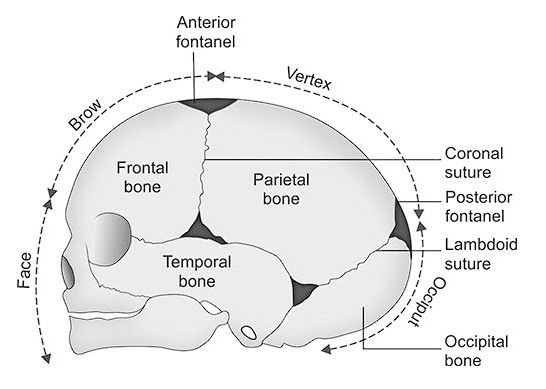
The fetal head has seven bones. Two frontal, two parietal, two temporal, and one occipital. Along the adjacent edges of these bones are sutures, and the meeting points of multiple skull bones are fontanels.
- Sagittal Suture: longitudinal, midline
- Frontal Suture: anterior suture between two frontal bones.
- Coronal Suture: anterior suture between frontal and parietal bones.
- Lambdoidal Suture: posterior suture between parietal and occipital bones.
Fetal Lie
The relationship of the long axis of the fetus to the long axis of the mother’s uterus/spine.
- Longitudinal: the fetal and maternal axes are parallel. This can be further classified as cephalic or breech presentation depending on which part enters the pelvis first.
- Transverse Lie: the long axis of the fetus is perpendicular to the mother’s spine; shoulders present.
Fetal Attitude
The relationship of the fetal parts to the trunk or to one another.
- Flexion: the desired attitude.
- Extension
Fetal Presentation
The lowermost part in the pelvic inlet; the part felt upon internal examination.
- Cephalic: the head is the presenting part.
- Vertex: head acutely flexed
- Sinciput: head moderately flexed
- Brow: head moderately extended
- Face: head acutely extended
- Breech: the buttocks are the presenting part. FHT is felt at the upper quadrants or above the level of the umbilicus, and with the findings of Leopold’s maneuvers 1 (hard, round, ballottable mass) and 3 (soft, globular, non-ballottable mass).
- Complete (Full): feet and legs are flexed on the thighs; buttocks and feet presenting; fetus squatting; the type favoring most the second stage of labor as the feet could be used as traction.
- Incomplete (Frank): thighs flexed against the abdomen; legs extending up to the shoulders as they lie on the anterior chest; buttocks present; the type favoring most the first stage of labor as the large buttocks are a good dilating wedge.
- Footling (single or double): one foot or two present; the type is easily complicated by cord prolapse.
Meconium Staining
If the fetus is breeched, the passage of meconium staining is not a sign of fetal distress.
- Shoulders: usually referred to as a transverse lie; the fetal long axis lies perpendicular to the maternal spine, and the fetus appears to lie crosswise in the uterus.
Fetal Position
Position refers to the relationship of the denominator or landmark of the presenting part to the front imaginary quadrants of the mother’s pelvis. Assessment of the position can be done through Leopold’s maneuvers, vaginal examination, and rectal examination (obsolete).
- Chosen Landmarks/Denominators:
- Occiput (O) for vertex presentation
- Mentum (M) for face presentation
- Sacrum (S) for breech presentation
- Acromiodorso (AD) for shoulder presentation
- Four Imaginary Quadrants:
- Left anterior
- Right anterior
- Left posterior
- Right posterior
| Occiput | Mentum | Sacrum | Acromiosdorso | |
|---|---|---|---|---|
| Left Anterior | LOA | LMA | LSA | LAPA |
| Right Anterior | ROA | RMA | RSA | RAPA |
| Left Posterior | LOP | LMP | LSP | LAPP |
| Right Posterior | ROP | RMP | RSP | RAPP |
- Left occipitoanterior (LOA) features the occiput pointing towards the mother’s left abdominal wall, face is down towards the maternal right buttocks; most common and favorable position.
- Occiputposterior (OP), either left (LOP) or right (ROP), is a factor in prolonged labor, with the mother experiencing much discomfort (backache) during labor. Comfort measures: side-lying, backrub, counter-sacral pressure during contractions.
Fetal Station
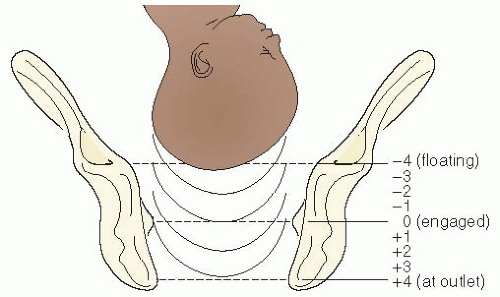
Station refers to the relationship of the presenting part to the ischial spines, the single most important landmark of the pelvis. It measures how far the presenting part has descended into the pelvis— the degree of descent. Each station is one centimeter and determined through internal examination.
- Floating (High; Ballottable): unengaged presenting part
- Station 0: the presenting part is at the level of the ischial spines.
- Minus Station (Negative): if the presenting part is above the level of the ischial spines, station is expressed as a negative number (e.g., -1 (1 cm above), -2 (2 cm above)).
- Plus Station (Positive): if the presenting part is below the ischial spines (outlet), station is expressed as a positive number (e.g., +1 (1 cm below), +2 (2 cm below)).
| Score | Meaning |
|---|---|
| -5 to 0 | The “presenting” or most palpable (able to feel) part of the baby is above the woman’s ischial spines. |
| 0 | The baby’s head is known to be “engaged,” or aligned with the ischial spines. |
| 0 to +5 | Positive numbers are used when a baby has descended beyond the ischial spines. During birth, a baby is at the +4 to +5 station. |