
References:
- Community and Public Health Nursing, 2nd Philippine Edition, ISBN 978-981-48-6503-6, by Earl Francis R. Sumile
Vital Statistics
Vital statistics is the study of the characteristics of human populations. It comprises a number of important events in human life including birth, death, fetal death, marriage, divorce, annulment, judicial separation, adoption, legitimation, and recognition. Some of these vital statistics are used in identifying health-related concerns and planning for interventions at the community or country level. Their subsequent analysis and interpretation are essential for setting targets and evaluating social and economic plans, including the monitoring of health and population intervention programs, and the measurement of important demographic indicators of levels of living or quality of life, such as expectation of life at birth and the infant mortality rate. The health sectors depends on patterns and causes of mortality and morbidity to identify emerging health threats and possible high risk groups for selecting priority interventions and allocating resources.
Individual Records
The collection of vital statistics is included in the civil registry system. Vital statistics is important as a legal document for the person named as well as a document to describe the demographics and health of populations. The most important individual records include birth, death, marriage/divorce. They are also used for program planning, such as in maternal and child health services, child immunization programs, epidemic or outbreak investigations and assessment of causes of accidents and injuries.
- Birth record is a legal document establishing name, parentage, birth date, order of birth, legitimacy, citizenship, nationality, geographic place of birth. Many individual rights and entitlements are dependent on the birth record, such as entry to school, driver’s license, passport issuance, tax/insurance benefits, etc.
- Death record is a documentary proof surrounding the death of the person such as time and place of death as well as medical cause of death. Proof of death and the associated facts are usually used for property inheritance rights and right to remarry of surviving spouse.
- Marriage and divorce records are usually needed for social and economic programs, tax privileges for couples, alimony, change of nationality, and right to remarry.
- Records on adoption, legitimation and recognition are used for determining rights of individuals (children, parents, guardians), which may vary from one country to another.
Population Records
Vital records of populations serve as key demographic variables in the analysis of population size, growth and geographic distribution. Population census can show population size and growth trends, as well as socio-economic concerns such as health, housing, education, family structure, occupation, and income. For example, “Life expectancy at birth” is used to compare the overall effects of mortality and its determinants. “Cause of death” is also important as it provides the foundation upon which more research is needed.
Population Indicators
Population indicators include population growth indicators (crude birth rate, general fertility rate, total fertility rate, and annual growth rate) and other population dynamics (migration) that can affect the age-sex structure of the population.
- Crude Birth Rate (CBR): the absolute rate at which the population grows. It is the most frequently used overall measure of the reproduction of a population. It is termed as “crude” because this value counts the total population including men, children, and the elderly who are not capable of giving birth. Like the Crude Death Rate (CDR), the CBR is widely used because of its availability of data which go into its computation.
- , where is the total number of live births for a given area and time period, is the total population at the midpoint of the time period, and is a constant, usually taken as 1000.
- A CBR greater than or equal to 45 live births per 1000 population implies high fertility, while a level less than or equal to 20 live births per 1000 population implies low fertility.
- General Fertility Rate (GFR): is the number of live births per 1000 women aged 15 to 49 in a given year.
- , where is the number of registered live births in a year, is the midyear population of women 15 to 49 years of age, and is a constant, usually taken as 1000.
- A GFR greater than or equal to 200 live births in 1000 women implies high fertility, while a level less than 60 live births in 1000 women implies low fertility.
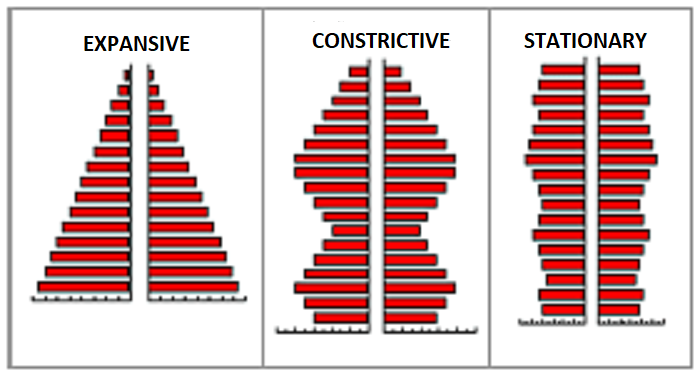
- Population Pyramid: a graphical representation of the age-sex composition of the population. The shape of the pyramid provides insights into the fertility and mortality patterns of the population as well as the health services likely to be needed based on the age-sex composition of the population.
- A normal triangular shape of a population pyramid is characteristic of developing countries whose population has a larger proportion of younger age groups. This implies that more health services are needed for the young populations, such as immunization, nutrition programs, and environmental measures to prevent common childhood illnesses.
Live Birth
A live birth is defined as the complete expulsion or extraction from its mother of a product of conception, irrespective of the duration of the pregnancy, which, after such separation, breathes or shows any other evidence of life, such as beating of the heart, pulsation of the umbilical cord, or definite movement of voluntary muscles, whether or not the umbilical cord has been cut or the placenta is attached.
Mortality Indicators
Mortality indicators provide important information of the health status of the people in the community. A mortality rate is a measure of the frequency of occurrence of death in a defined population during a specified interval.
- Crude Death Rate (CDR) is the rate with which mortality occurs in a given population. CDR are sensitive to the number of people at the highest risk for dying. A relatively older population will likely produce a higher CDR. It is often expressed as the number of deaths per 1000 persons for a specified place for a given year.
- , where is the number of deaths in a given area and time period, usually a calendar year, is size of the population at risk of dying, and is a constant, usually taken as 1000.
- The Philippine CBR in 2016 was ~6 persons per thousand population.
- Specific Death Rate (SDR) is a subset of CDR representing a particular class of deaths. If based on age, termed as age-specific death rate; on gender, sex-specific death rate; on cause of death, cause-specific death rate.
- , where is the number of deaths occurring in the th class in a given area and time, is number of persons in the th class of the population in the same area and time, and is a constant, usually 100000.
- In the Philippines, the age-specific death rate has an early peak in infants, then lowers in children before slowly increasing again through adulthood and the elderly.
| Cause of Death (PSA, 2016) | Frequency | Percent |
|---|---|---|
| Ischemic heart diseases | 74,134 | 12.7 |
| Neoplasms | 60,470 | 10.4 |
| Pnuemonia | 57,809 | 9.9 |
| Cardiovascular diseases | 56,938 | 9.8 |
| Hypertensive diseases | 33,452 | 5.7 |
| Diabetes mellitus | 33,295 | 5.7 |
| Other heart diseases | 28,641 | 4.9 |
| Respiratory tuberculosis | 24,462 | 4.2 |
| Chronic lower respiratory infections | 24,365 | 4.2 |
| Diseases of the genitourinary system | 19,759 | 3.4 |
- Proportionate Mortality Ratio (PMR) describes the proportion of deaths in a specified population over a period of time attributable to different causes. It may be calculated for any class of deaths, but their most common uses are for given causes or group of causes of death expressed as percentages of deaths from all causes, or for deaths at a specified age expressed as percentages of deaths at all ages.
- , where is the number of deaths occurring in the th class in a given area and time, is total number of deaths in the same time period, and is a constant, usually 100 or 1000.
- Maternal Mortality Rate (MMR) refers to the deaths related to pregnancy or childbirth. This is affected by maternal health practices, diagnostic ascertainment, and completeness of registration of births.
- , where is the number of direct maternal deaths in a specified time period, usually one year, is the number of indirect maternal deaths in the same period, is the number of live births in the same period, and is a constant, usually 10000 or 100000.
- Infant Mortality Rate (IMR) refers to the number of deaths per 1,000 live births of children under one year of age. It is considered as one of the important indicators of the overall level of health and social well-being of a country or other geopolitical area since many causes of death at this age group are considered to be preventable through adequate prenatal care, good nutrition for women and infants, and improved control of the environment.
- , where is the number of deaths to liveborn infants under one year of age during a specified time period, usually one year, is the total number of live births during the same time period, and is a constant, usually 1000.
- Neonatal Mortality Rate (NMR) refers to the number of deaths per 1,000 live births of children within 28 days postpartum. These deaths are due mainly to prenatal or genetic factors, while those in later months are influenced by environmental and nutritional factors as well as infections.
- , where is the number of deaths to liveborn infants under one month of age during a specified time period, is the total number of live births during the same time period, and is a constant, usually 1000.
- Postneonatal Mortality Rate (PNMR) refers to the number of deaths per 1,000 live births of children aged 29 days to 1 year.
- , where is the number of deaths to liveborn infants between one month and one year of age during a specified time period, is the total number of live births during the same time period, and is the same constant used in NMR, usually 1000.
- Early Postneonatal Mortality Rate (EPNMR): neonatal deaths may be partitioned into those dying within the first week of life and the remainder that survive the first seven days but die before one month of age. The risk of dying in the first week of life is measured by the EPNMR.
- , where is the number of deaths to liveborn infants dying within one week of age during a specified time period, is the total number of live births during the same time period, and is the same constant used in NMR, usually 1000.
- Perinatal Mortality Rate (PeMR): a combination of the deaths of fetuses of specified gestational age with deaths of liveborn infants who die in their first week of life.
- , where is the number of deaths of fetuses of 22 or more weeks of gestation plus deaths of liveborn infants of less than 7 days of age during a specified period, usually a calendar year, is the number of fetal deaths of 22 or more weeks of gestation during the same period, is the number of live births during the same period, and is a constant, usually 1000. comprises total births.
Patterns of Occurrence and Distribution of Disease
The central goals of epidemiology are describing the disease patterns, identifying the etiological factor in disease development, and taking the most effective preventive measures. In describing disease patterns and occurrence, two important concepts must be understood: risk and rate.
- Risk refers to the probability or chance of an adverse effect. Risk factor refers to specific exposure factors; such as high cholesterol, lack of physical activity, cigarette smoke, hypertension, and excessive stress, which are known risk factors for noncommunicable diseases. Risk factors may also be intrinsic factors or fixed characteristics of people; such as: age, sex, genetic make-up. Disease patterns are described as aggregates, with the effect of risk factors measured in disease rates.
- Rate is a population proportion in which the numerator is the number of events occurring in a specified period and the denominator consists of those in the population at the specified time period, multiplied by a constant (), i.e., a rate can be the number of cases of a disease occurring for every 100,000 people in the population. Rates allow for meaningful comparison of magnitude of health problems or diseases across countries, groups, or time periods.
Morbidity Rates
Morbidity is any departure, subjective or objective, from a state of physiological or psychological well-being.” in practical language, it comprises disease, injury, and disability. Morbidity rates can refer to incidence or prevalence:
- Incidence denotes the proportion of initial cases of a disease to a population; an incidence rate. It describes the occurrence of new cases in a disease or condition in a community over a given period relative to the size of the population at risk for that disease or condition during that same period.
- The incidence rate is considered as the most sensitive indicator of the changing health of a community because it entails the follow-up of a cohort of disease-free people who are at risk of developing the disease of interest within a specified period of time and thereby captures the fluctuations of disease in a population. It is valuable for monitoring trends in chronic disease, useful for detecting short-term changes in acute disease such as influenza or measles, and evaluating the effectiveness of health interventions.
- “Attack Rate” is often used for specific infectious diseases at a given time in place, as it measures the number of new cases of a disease in those exposed to the disease.
- Prevalence denotes the proportion of initial and existing cases of a disease to a population; a prevalence rate. It describes the number of all cases of a specific disease or condition in a population at a given point in time relative to the population at the same point in time.
- “Point prevalence” is a prevalence rate during a specific point. “Period prevalence” is a prevalence rate during a period or interval of time.
- Prevalence proportion measures the total number of existing cases of a disease at a particular point in time divided by the number of people at that point in time, e.g., during an examination ()
Changes in incidence or prevalence may result from some of the following:
- Changes in local reporting procedures or policies
- Changes in case definition
- Increased health-seeking behavior (e.g., media publicity prompts persons with symptoms to seek medical care)
- Increase in diagnosis
- New laboratory test or diagnostic procedure
- Increased physician awareness of the condition
- Increase in reporting (i.e., improved awareness of requirement to report)
- Outbreak of similar disease, misdiagnosed as disease of interest
- Laboratory error
- Batch reporting (i.e., reports from previous periods are held and reported all at once during another reporting period)
| Diseases (DOH, 2010) | Number | Rate |
|---|---|---|
| Acute respiratory infection | 1,289,168 | 1371.3 |
| Acute lower respiratory tract infection and pneumonia | 586,186 | 623.5 |
| Bronchitis/Bronchiolitis | 351,126 | 373.5 |
| Hypertension | 345,412 | 367.4 |
| Acute watery diarrhea | 326,551 | 347.3 |
| Influenza | 272,001 | 289.3 |
| Urinary tract infection | 83,569 | 88.9 |
| TB, respiratory | 72,501 | 77.1 |
| Injuries | 51,201 | 54.5 |
| Diseases of the heart | 37,589 | 40.0 |